
Imagine this: A single, simple root word like act—meaning "to do" or "to perform"—sits at the heart of dozens of everyday and academic words your students encounter. One root, combined with prefixes and suffixes, explodes into an enormous family of related words, transforming a basic idea into precise, powerful vocabulary.
Here is a morphology matrix for the word act. You can see here that we can form lots of words and derive meaning from understanding the root word and the prefixes and suffixes. Luckily we should only need to teach the meanings of the prefixes and suffixes once.
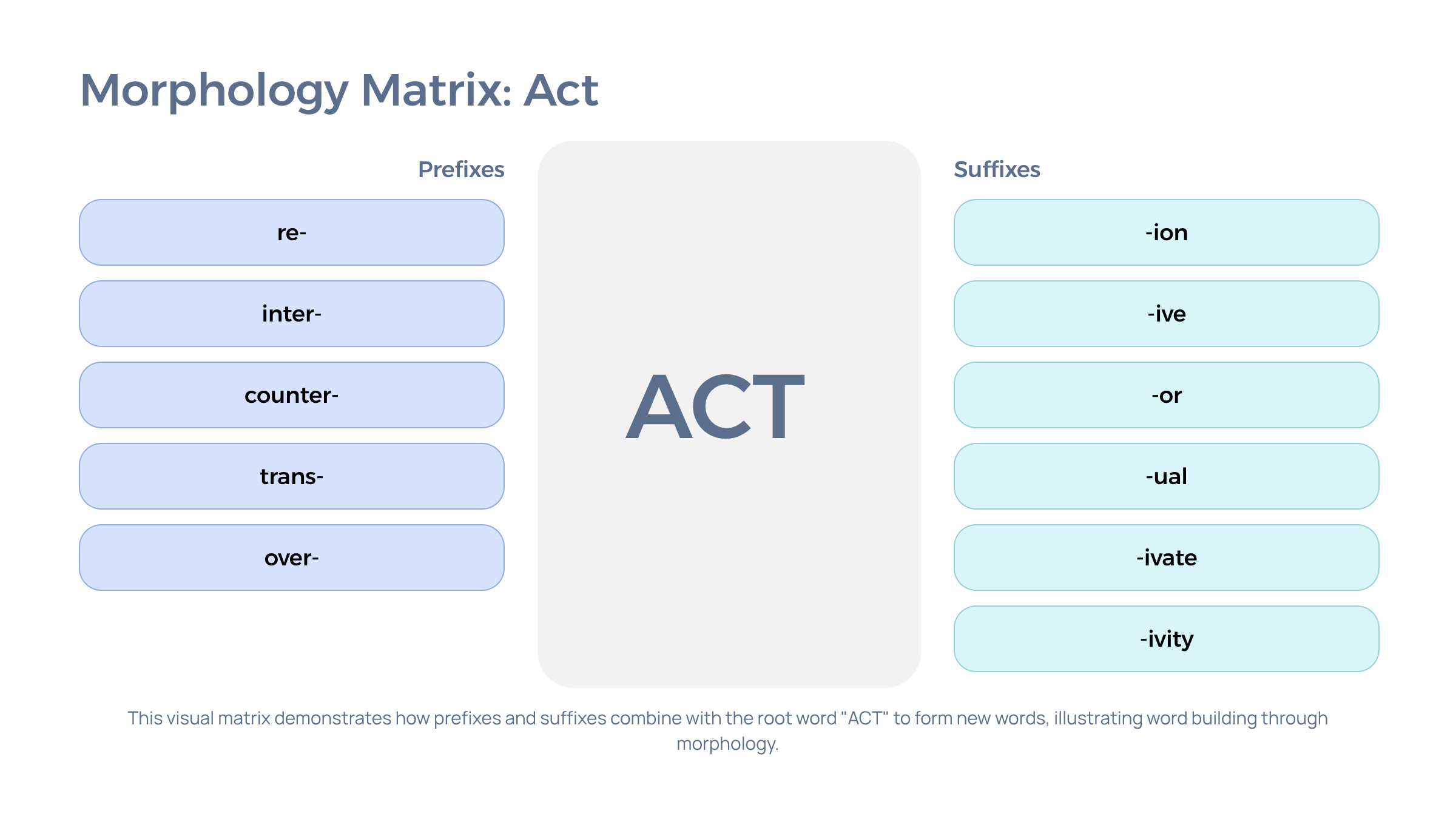
From just this one root, students can build and understand words like:
- act (the base itself)
- action (noun: something done)
- active (adjective: full of energy or doing)
- actor (noun: one who performs/acts)
- acting (verb form: in the process of doing)
- acted (past tense)
- reaction (noun: response to an action)
- reactive (adjective)
- reactor (e.g., in science: a device for reaction)
- inaction (noun: lack of action)
- inactive (adjective)
- interaction (noun)
- interactive (adjective)
- transaction (noun: an exchange/action)
- transactional (adjective)
- activity (noun)
- activism (noun)
- activist (noun: one who promotes action for change)
- actionable (adjective: able to be acted upon)
That's over 20 words—and many more exist—from one root!
Just to emphasise the point, here is a morphology matrix for port.
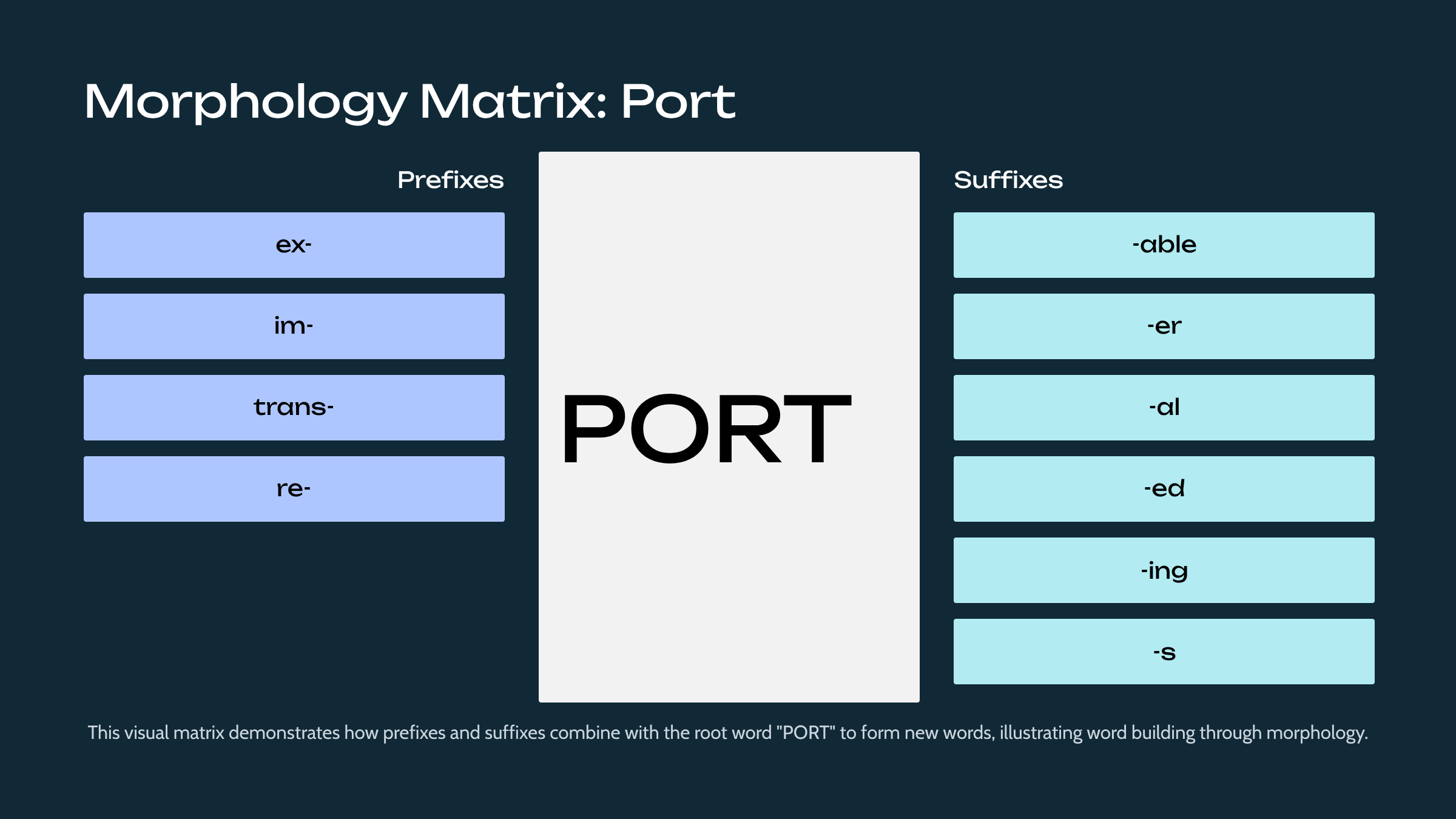
Suddenly, a child who knows act or port can decode and infer meanings for unfamiliar words in reading, spell them more accurately, and use sophisticated vocabulary in writing. Instead of memorizing isolated lists, they see the system: suffixes like -ion turn verbs into nouns (action), -ive makes adjectives (active), -or creates agents/doers (actor), -ist forms specialists (activist), and -able indicates capability (actionable).
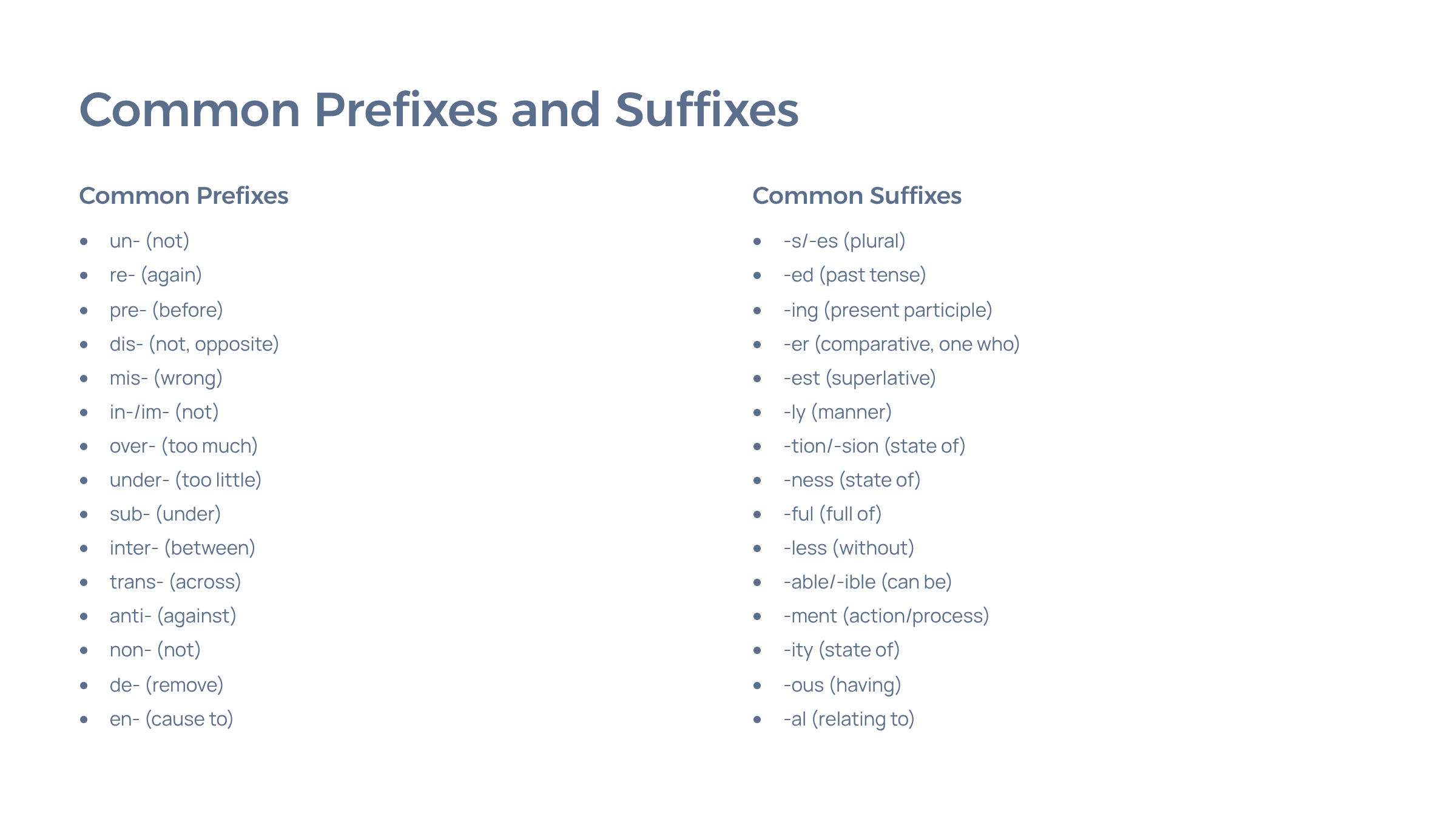
This is the magic of morphology—and suffixes are often the star players, shifting parts of speech and nuance while keeping the core meaning tied to the root. Teaching this explicitly shows students that English isn't random chaos; it's logical and generative.
Below, for members you will find my handy suffixes guide for teachers. This guide includes a progression pathway for suffixes from Year 1 to Year 6 and includes a wide variety of teaching ideas.
Happy Teaching
The EAL School Team.